TÉL: +86-177 3033 8505 EMAIL: info@cnwali.com
Contact |
 Déchiqueteuse Wali
Project Background
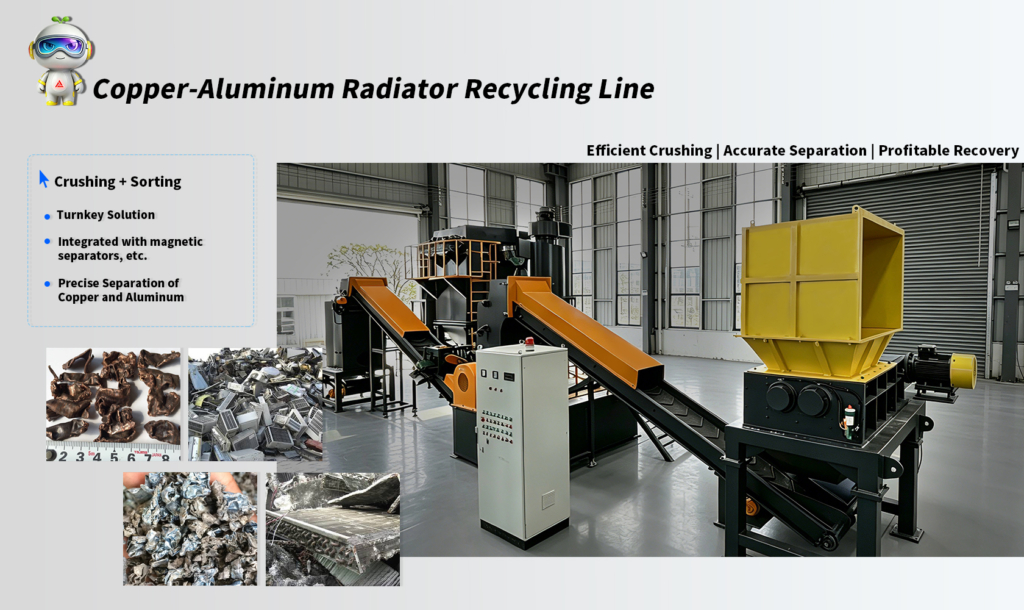
A Nigerian customer has long been engaged in scrap metal recycling, primarily purchasing copper-aluminum radiators from locally dismantled end-of-life vehicles and air conditioners. These radiators consist of copper tubes and aluminum fins tightly press-fitted together, making the copper-aluminum bond extremely strong and manual dismantling highly inefficient.
The customer’s core requirement was clear: separate copper and aluminum to sell each at its true market value.
Material Characteristics: Why Are Copper-Aluminum Radiators Difficult to Process?
Copper-aluminum radiators are made by mechanically press-fitting or brazing copper tubes and aluminum fins, creating a tight bond and strong structural integrity. This composite structure presents two key processing challenges:
⇒Challenge 1: Difficult Liberation. Copper and aluminum differ significantly in ductility – copper is ductile, deforming under force but resisting fracture, while aluminum fins are thin and brittle, fracturing easily under force. Manual dismantling or simple shredding struggles to fully separate the two – copper tubes often retain aluminum residue, and aluminum fins still contain copper fragments.
⇒Challenge 2: High Sorting Precision Required. Both copper and aluminum are non-magnetic, so magnetic separation cannot separate them. Their density difference alone is also insufficient for high-purity gravity separation (cuivre: 8.9 g/cm³; aluminium: 2.7 g/cm³ – but after shredding, irregular particle shapes make settling velocity differences unstable). Copper-aluminum separation must rely on eddy current separation – using the difference in induced currents generated by the two metals’ different electrical conductivity.
Donc, the technical core of a copper-aluminum radiator recycling line is not “how fine it shreds,” but “how thoroughly it liberates and how precisely it sorts.”
Process Route: Three-Stage Shredding + Multi-Stage Sorting
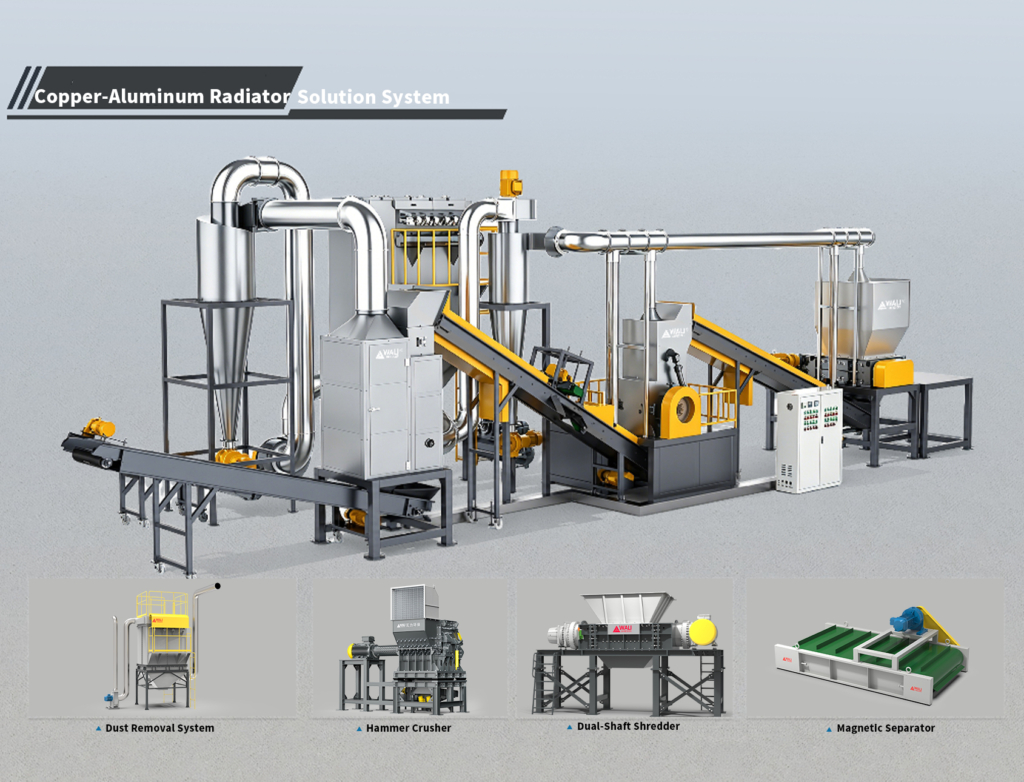
Wali’s copper-aluminum radiator recycling line adopts a core process of “Shredding → Hammer Crushing → Air Classification,” supplemented by magnetic separation and air separation for purification, ultimately yielding pure copper and aluminum granules.
⇒Scène 1: Shredding – Breaking the Copper-Aluminum Bond
Whole radiators are fed into a twin-shaft shredder. The shearing force generated by two counter-rotating shafts tears large radiators into 50–100mm pieces.
The key here is controlling shredding intensity: too coarse, and the copper-aluminum bond isn’t sufficiently broken for downstream hammer crushing; too fine, and aluminum fins are over-pulverized into aluminum powder, increasing sorting difficulty and metal loss. The twin-shaft shredder’s low-speed, high-torque characteristics perfectly match this requirement – enough force to break the structure without over-pulverizing.
⇒Scène 2: Hammer Crushing – Liberation Through Ductility Differences
The coarsely shredded material enters a hammer crusher, where high-speed rotating hammers repeatedly strike the material.
This is the most technically demanding stage. Copper and aluminum behave differently under hammer impact:
¹Copper tubes: Ductile – hammered into spherical or blocky copper granules, resisting fracture
²Aluminum fins: Thin and brittle – hammered into fine aluminum granules or flakes
√This ductility difference allows copper and aluminum to naturally “separate” during hammer crushing. Output particle size is controlled by a bottom screen, typically set at 20–40mm, ensuring sufficient liberation while avoiding over-pulverization.
Sorting – Air Classification as Core, Multi-Technology Synergy for Purification
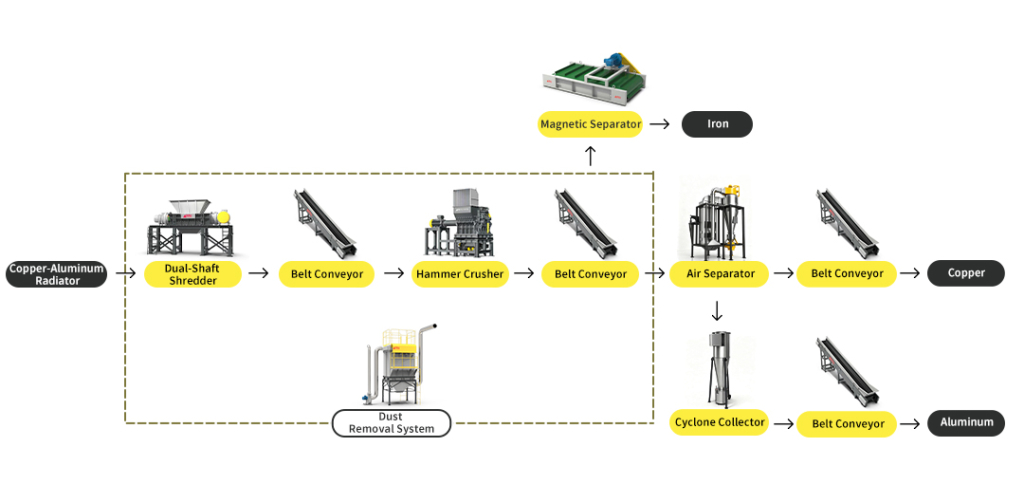
The crushed mixed material enters the sorting stage, purified step by step in the following order:
① Magnetic Separation: First removes any ferrous impurities to protect downstream equipment from iron damage.
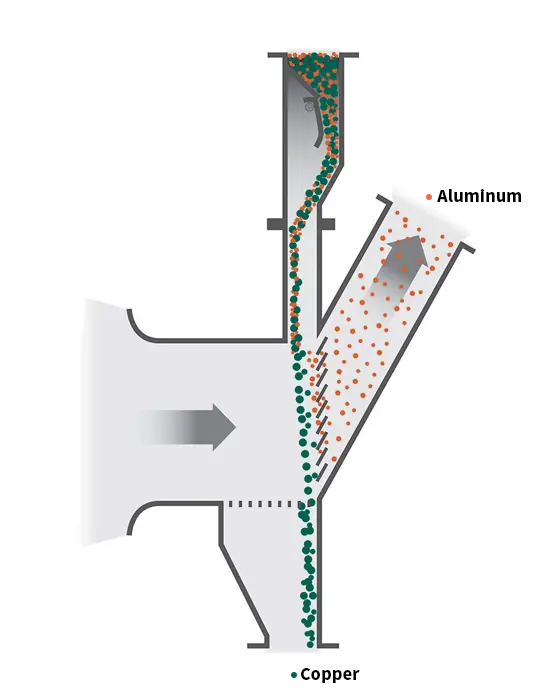
② Air Classification: This is the core step for copper-aluminum separation. The air classifier uses controlled airflow to separate copper and aluminum granules based on differences in density and particle shape.
Copper granules are denser and spherical or blocky, settling quickly in airflow; aluminum granules are lighter, flaky, or fine, easily carried away by airflow. By adjusting air volume and velocity, copper settles while aluminum is carried out – achieving separation.
The key lies in precise air velocity control – too low, and aluminum isn’t carried away, resulting in incomplete separation; too high, and copper is also carried away, causing copper loss.
For the customer’s actual material, we conducted multiple air velocity calibrations during trial runs to determine the optimal parameters.
③ Dust Collection System: Further separates lightweight impurities (plastic fragments, caoutchouc, poussière) and residual aluminum powder, improving aluminum granule purity.
Final Products:
Copper granules: Purity above 97% – directly sellable to copper smelters
Aluminum granules: Purity above 98% – directly sellable to aluminum smelters