 왈리 슈레더
Integrated Shredding & 혼입: The Logic Behind This Straw Processing Solution
Compact Footprint, Efficient Operation
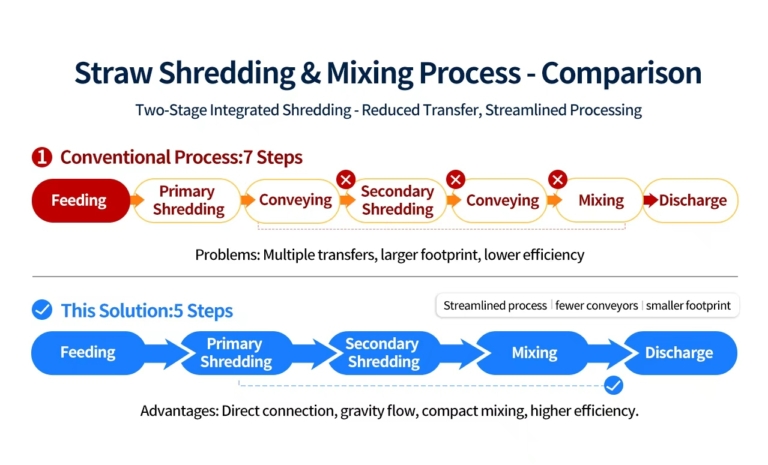
Straw pretreatment typically requires three steps: primary shredding, secondary shredding, and mixing with bacterial agents. The conventional approach uses three separate machines connected by conveyors – large footprint, multiple steps, and material handling back and forth.
This design vertically stacks two shredders and one mixer. Material enters from the top and flows downward through all stages. Compared to traditional horizontal layouts, floor space is reduced by 30%–50%, while eliminating at least two conveyors and intermediate transfer steps.
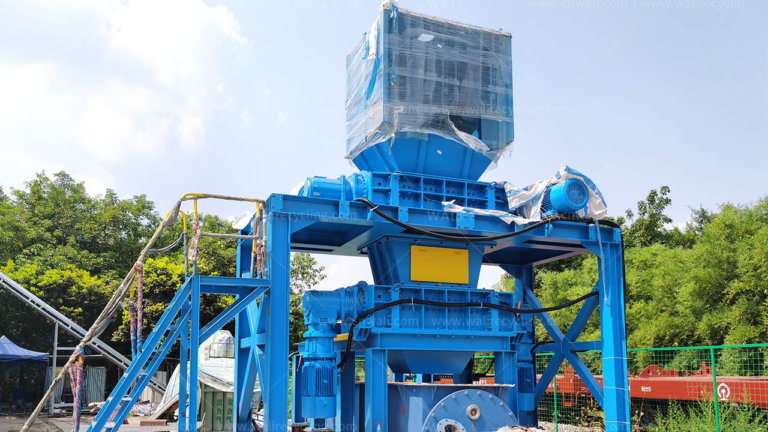
Two-Stage Shredding for Uniform Output
Straw is bulky, long-fibered, and prone to tangling. A single shredder struggles to achieve optimal results – insufficient shredding leads to poor mixing, while over-shredding generates excessive dust.
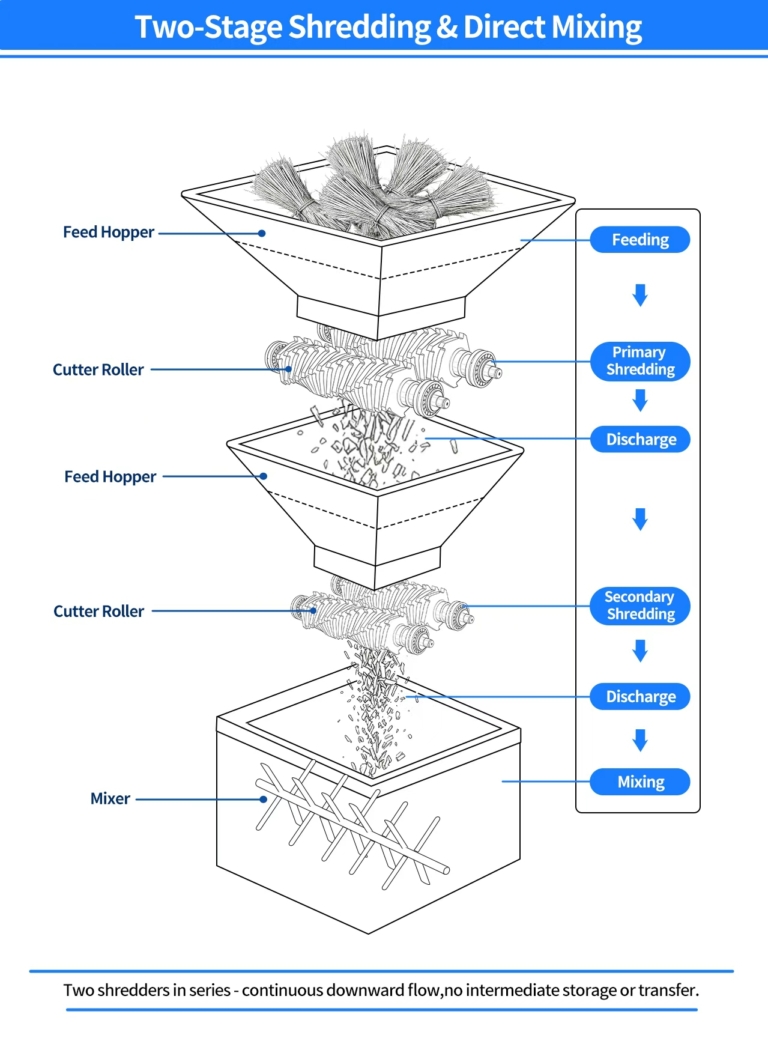
Two shredders stacked vertically create a two-stage process:
First stage (upper): Primary shredding – cuts whole bales or long stalks, reducing volume
Second stage (아래): Fine shredding – further reduces material to target particle size
Two-stage shredding ensures more uniform particle size, avoiding the problem of “large pieces under-shredded, fine powder over-shredded.”
The two shredders work in close coordination with no intermediate storage or transfer – material exits the first and immediately enters the second, making the process compact and efficient.
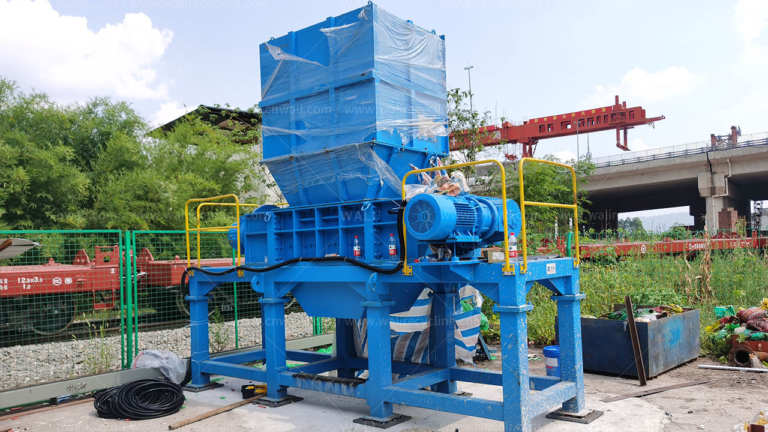
Integrated Shredding & Mixing – One Less Machine, One Less Step
After shredding, straw must be thoroughly mixed with fermentation agents before entering the fermentation stage. The more uniform the mixing, the higher the fermentation efficiency and the better the gas yield or composting results.
The conventional approach:
shred → collect → transfer to mixer → load and mix.
This design places the mixer directly below the second shredder. Shredded material falls by gravity directly into the mixer, where it is thoroughly blended with fermentation agents. Shredding and mixing are completed in one vertical flow – eliminating an intermediate transfer step and avoiding material spillage and loss.
Properly mixed material is ready for fermentation – whether for biogas or composting, uniform mixing significantly shortens the fermentation cycle and improves output efficiency.
-END-